The Beginner Witch’s Guide to Tarot: Read Every Card with Intuition
Tarot for beginners does not have to begin with memorizing all 78 card meanings. You can learn the structure of the deck, notice the symbols that catch your attention, and combine traditional meanings with your own intuition. This guide walks you through that process step by step.
Tarot has existed in different forms since at least the fifteenth century. The earliest known decks were created for card games in Europe, while their association with divination developed much later. Today, many people use tarot as a reflective practice: a way to slow down, consider a situation from another angle, and put difficult thoughts or feelings into words.
The cards do not guarantee predictions or provide unquestionable answers. Their value comes from the questions they raise, the patterns they help you notice, and the honest reflection they invite. Learning tarot is therefore less about memorizing a perfect definition for every card and more about combining observation, traditional symbolism, personal context, and thoughtful judgment.
A note about tarot: This guide presents tarot as a tool for reflection, creative inquiry, and personal insight. Tarot readings should not replace qualified medical, legal, mental-health, or financial advice, and they should not be treated as guaranteed predictions.
What Tarot Is and What It Can Help You See
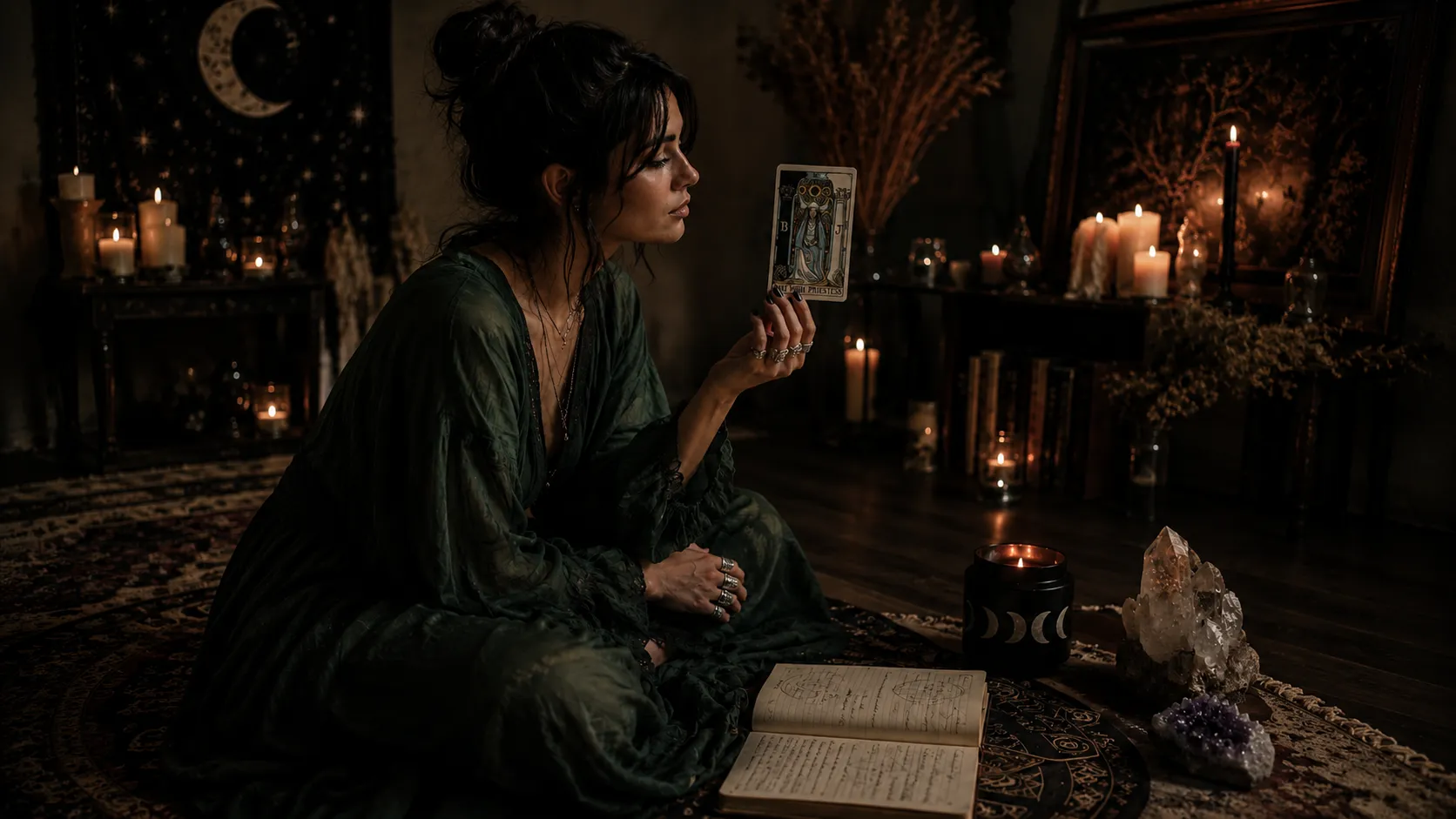
Many experienced readers recommend spending time with the artwork before trying to memorize every traditional meaning. Beginners sometimes skip this part because studying keywords feels more productive, but careful observation is one of the simplest ways to become familiar with a new deck.
Choose one card and look at it for two minutes, as you might study a painting. What catches your attention first? Which details feel comforting, tense, hopeful, or unfamiliar? What do you notice after looking again?
There is no single correct response. The purpose is to notice how the imagery communicates with you before consulting a guidebook. Over time, this practice can help you recognize recurring symbols, emotional tones, and visual patterns while still leaving room for established card meanings.
How the 78-Card Tarot Deck Works
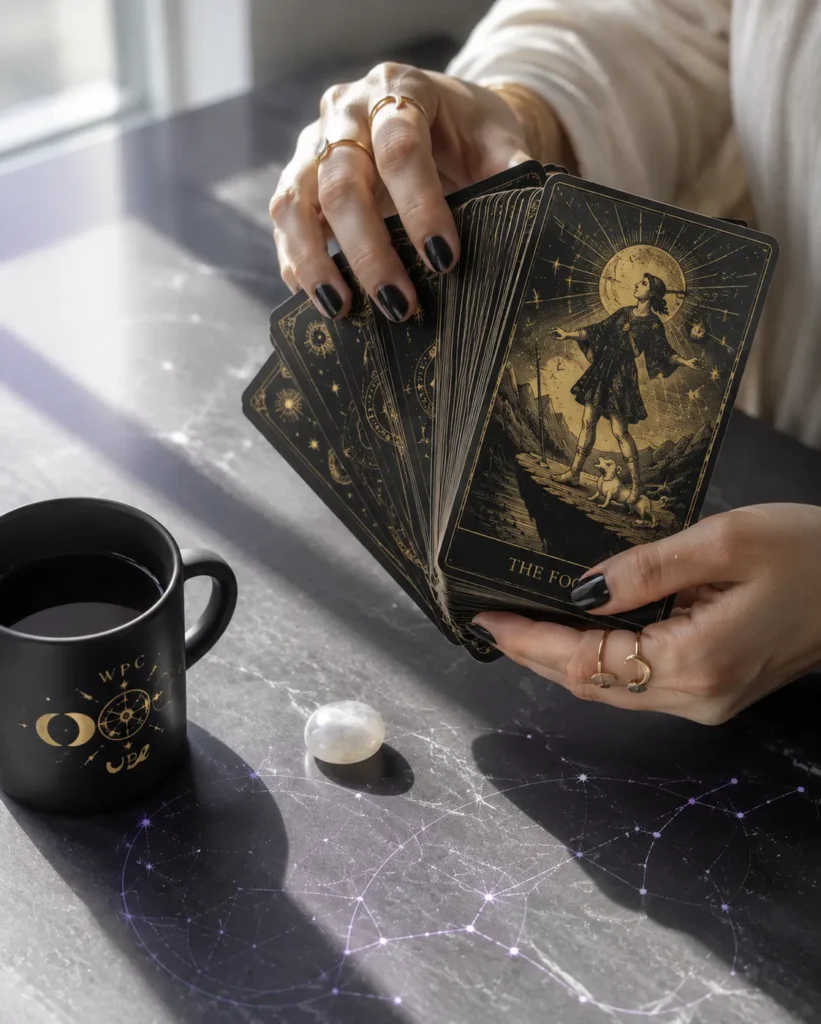
The tarot deck is not 78 individual, unrelated symbols to be memorized one by one. It has a clear architecture — three distinct sections with their own internal logic — and once you understand the structure, the cards stop feeling like a wall and start feeling like a map.
The Complete Tarot Deck at a Glance
Major Arcana: 22 Cards
The Fool through The World. Archetypal forces, life themes, and soul-level lessons. When a Major Arcana card appears, something significant is in motion.
Court Cards: 16 Cards
The Page, Knight, Queen, and King of each suit. Can represent people, personality aspects, or modes of energy — the most nuanced cards in the deck.
Reversed Tarot Cards
Any card drawn upside-down. Not inherently negative — three interpretive frameworks available, and you choose the one that resonates. More on this later.
Minor Arcana: 56 Cards
The everyday — emotions, actions, thoughts, and material circumstances — divided across four suits of 14 cards each. The texture of daily lived experience.
The Major Arcana
Archetypes, thresholds, and the story beneath the story
The Major Arcana is where most beginners instinctively begin, and with good reason: these 22 cards are the most symbolically rich, the most psychologically resonant, and — once you understand their internal logic — the most immediately readable of all 78.
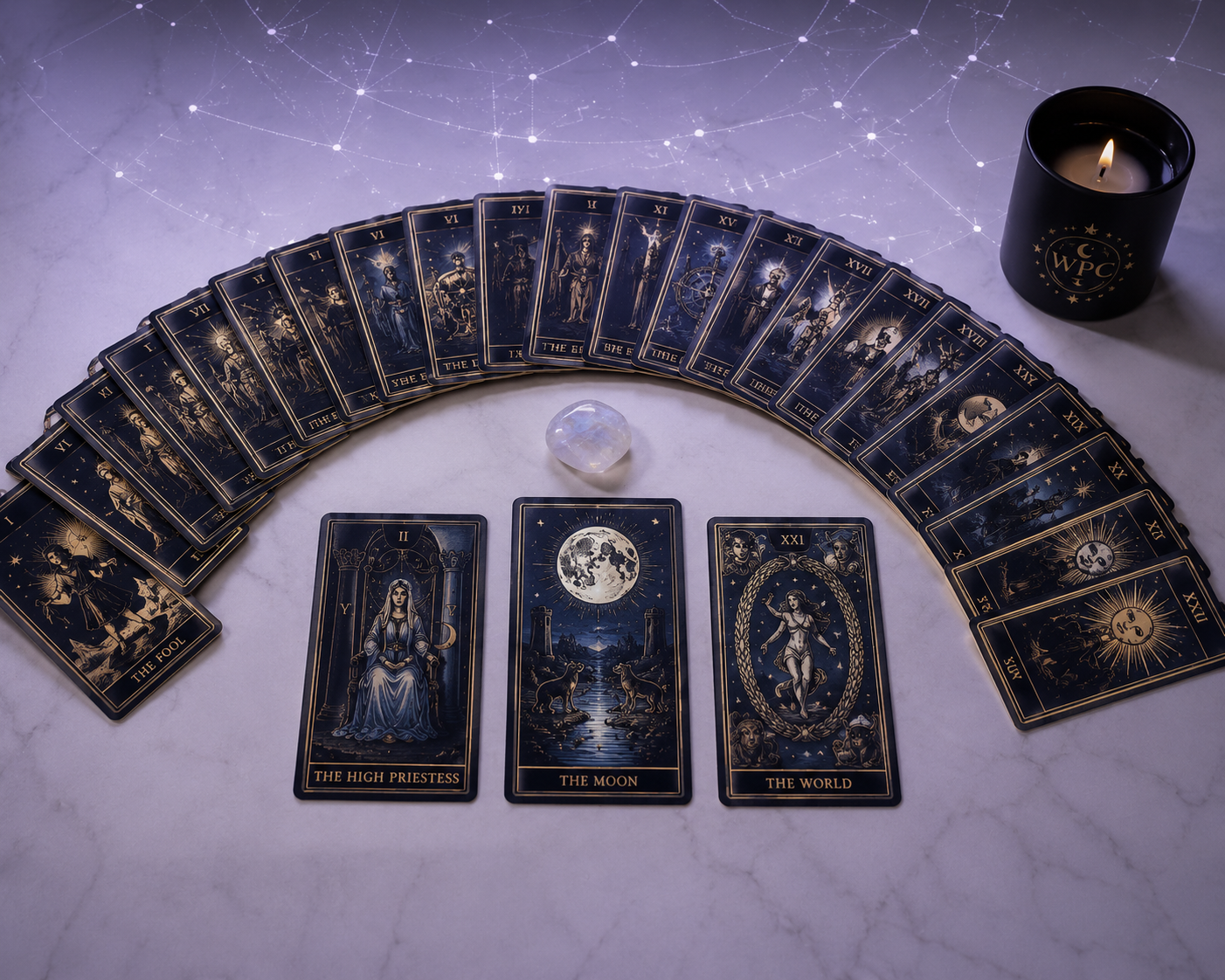
The Major Arcana tells a story. It begins with The Fool (numbered 0) — a figure stepping off a cliff into the unknown, full of potential and blissful unawareness — and ends with The World (numbered 21), a dancer in a wreath of completion, having integrated everything the journey required. Between those two cards is every experience a human life contains: love and loss, power and surrender, revelation and confusion, death and renewal.
The One Question to Ask About Every Major Arcana Card
Forget keywords. Forget memorized meanings. When a Major Arcana card appears in a reading, ask yourself this single question: where am I in this card’s journey right now? The Fool does not mean “you will make a mistake.” It means you are at a beginning — standing at the edge of something new, with more courage than information. The Tower does not mean disaster is coming. It means a structure in your life that was built on a false foundation is being cleared. The High Priestess does not mean “a mysterious woman.” She means there is knowledge available to you that is not yet visible — you are being asked to wait, and to trust what you sense before you can prove it.
The Major Arcana does not tell you what will happen. It tells you what kind of moment you are standing inside — and that is always the only information that matters.
Every Major Arcana card is an energetic state, a threshold, or an archetypal experience. When you locate yourself within it — “yes, I am in a Tower moment, a structure is falling” — the card stops being mysterious and starts being useful immediately.
From the cauldron
Tarot Tools for Your Practice
Decks, journals, and divination tools curated for the practitioner who reads with both knowledge and intuition — for every stage of the practice.
The Minor Arcana
The pattern that makes 56 cards feel like four
The Minor Arcana is where beginners typically feel most overwhelmed — 56 cards, 56 meanings to learn — until they discover the pattern that makes the entire section suddenly logical. The Minor Arcana is organized into four suits of 14 cards each, and each suit governs a distinct domain of human experience. Once you know the four suits, you know the territory of every Minor Arcana card before you read a single one individually.
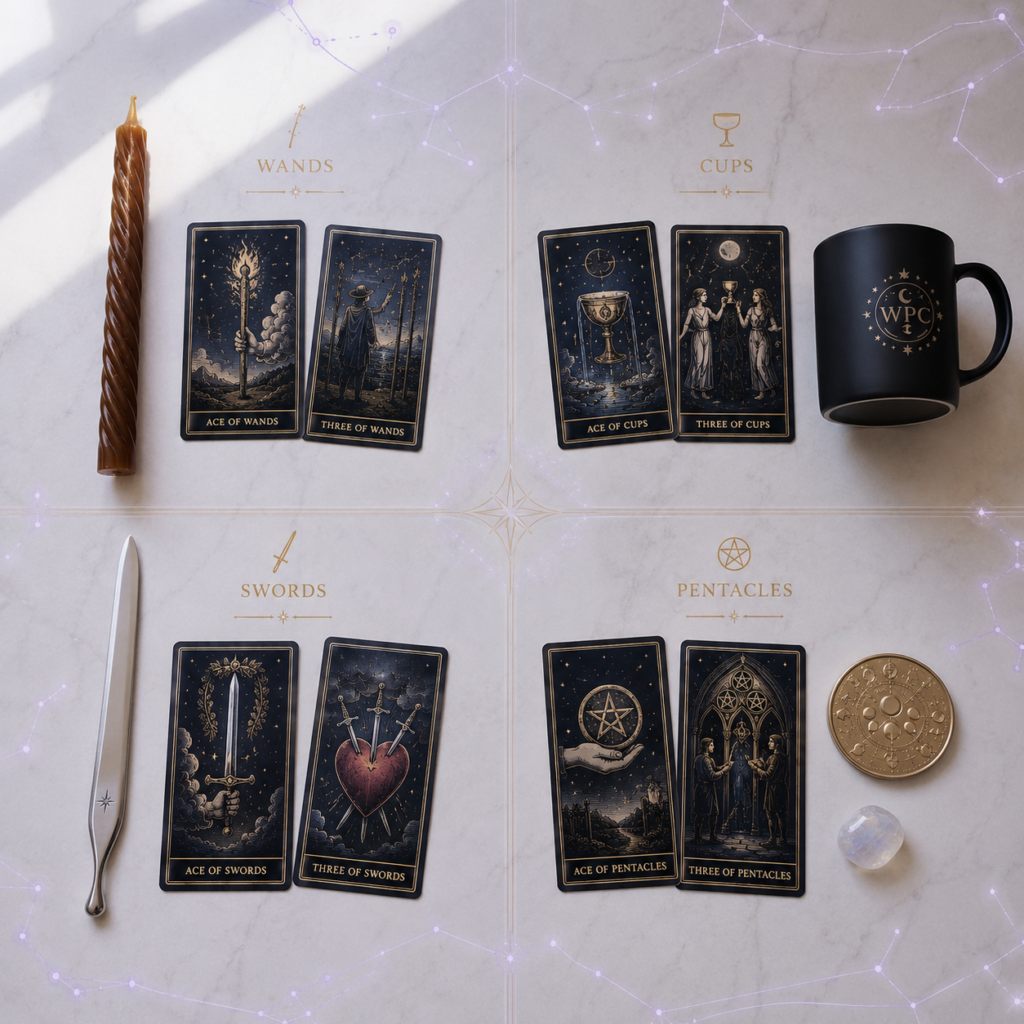
Wands
Fire · Passion · Action
CUPS
Water · Emotion · Intuition
Swords
Air · Mind · Truth
Pentacles
Earth · Body · Material
Each suit also runs from Ace through Ten, and the numbers carry their own consistent logic across all four suits. Aces are beginnings — pure elemental energy arriving fresh. Tens are completions — the fullest expression of that element, for better or worse. The middle numbers are the terrain in between: building (2–4), conflict or challenge (5), movement and change (6–8), near-completion (9). Once you internalize this numerical logic alongside the elemental suits, you can derive a working understanding of any Minor Arcana card from its number and suit alone — before you’ve ever studied a single keyword.
Court Cards
Every suit contains four court cards — the Page, Knight, Queen, and King — and they are consistently the cards that confuse beginners most. The reason is simple: unlike the numbered pip cards, which describe situations and experiences, court cards can mean three entirely different things depending on context, and traditional tarot books rarely explain this clearly.
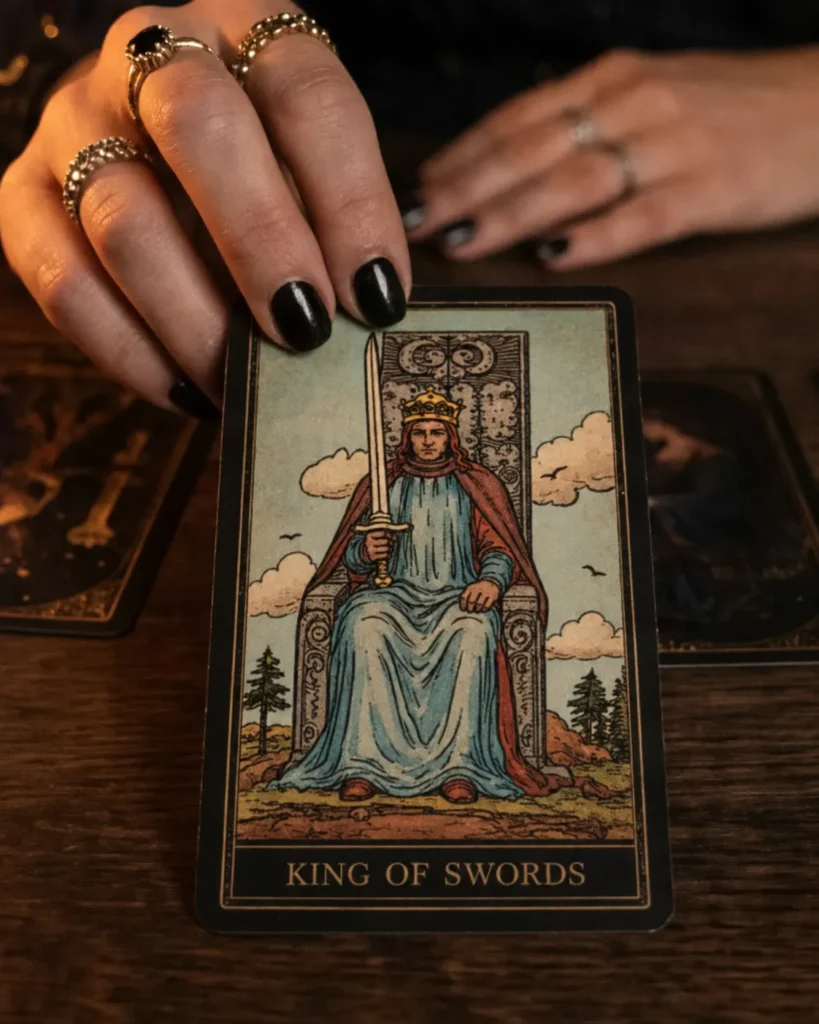
A person in your life.
The King of Swords might represent a sharp, analytical, authoritative person — a lawyer, a difficult parent, a mentor who cuts through illusion. The Queen of Cups might represent an empathic, intuitive woman in your circle. When the reading is clearly about relationships or external circumstances, look here first.
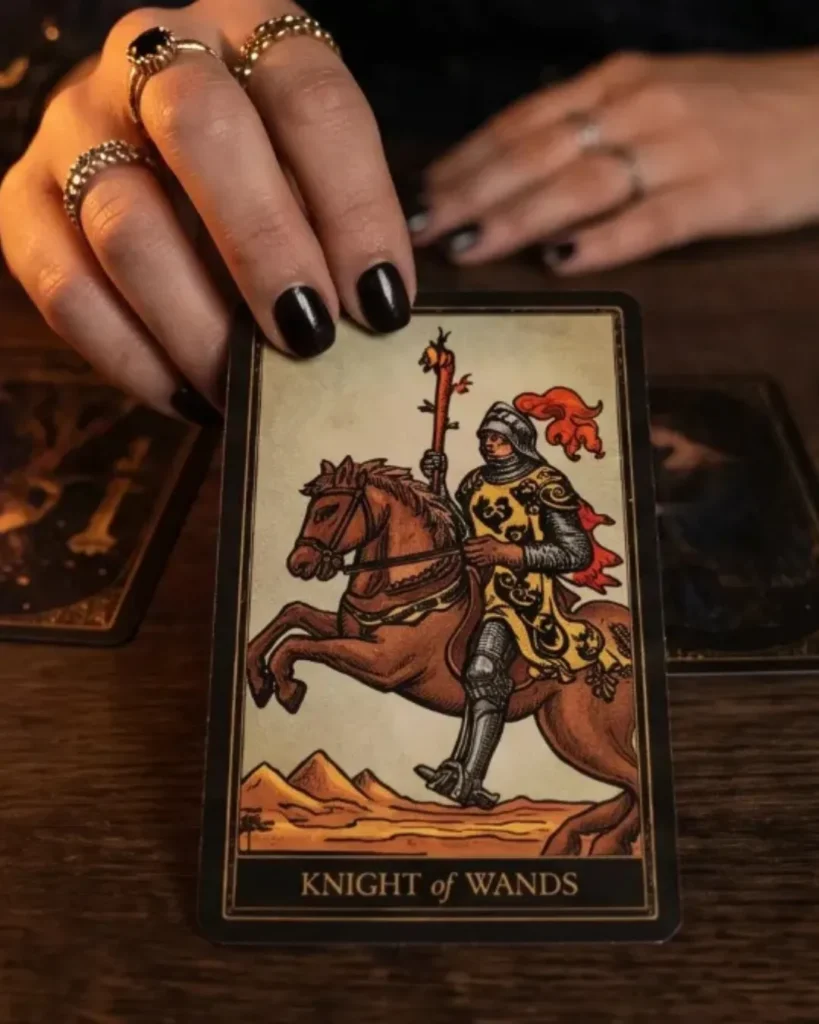
An aspect of yourself.
The Knight of Wands might represent the impulsive, passionate, charge-ahead energy you are currently embodying — or need to embody. Court cards appearing in positions about inner life almost always represent you.
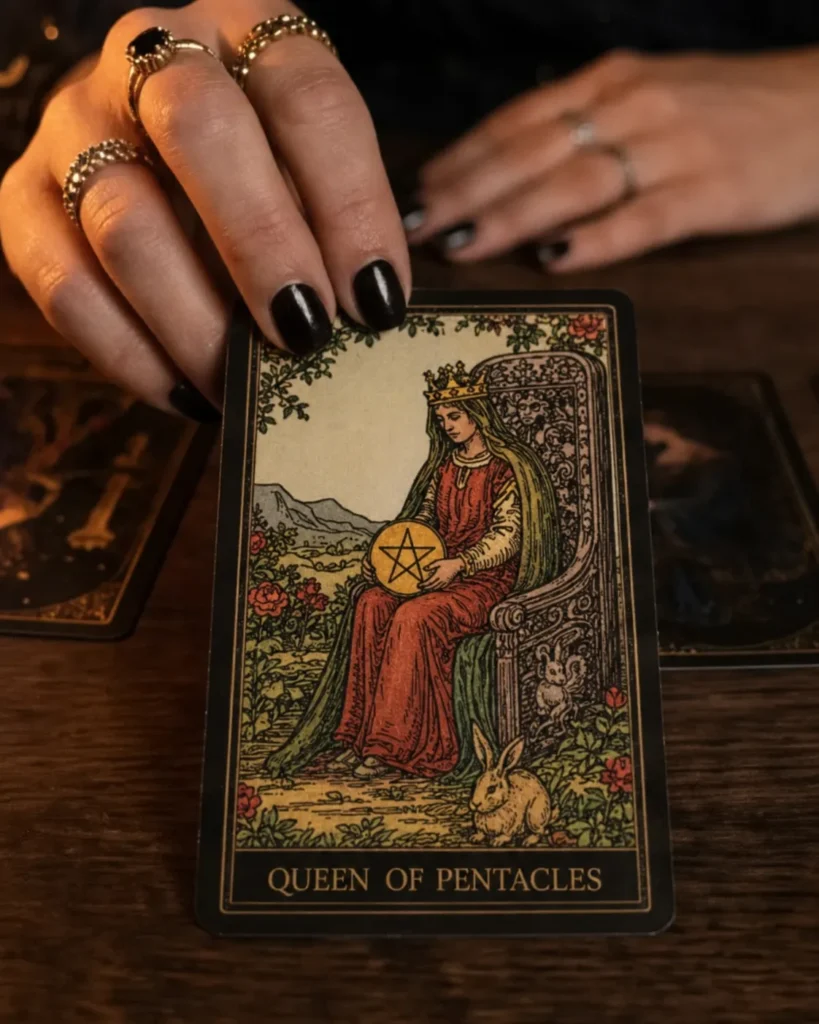
An energy or approach available to you.
The Queen of Pentacles might suggest bringing more nurturing, practical, grounded energy to a situation — not that such a person exists, but that this quality is what the moment calls for.
When a court card appears, begin by asking whether it seems to represent a person, an aspect of yourself, or a way of approaching the situation. Your first impression can offer a useful starting point, but it does not have to be your final answer. Consider the question, the card’s position in the spread, and the surrounding cards before deciding which interpretation fits best.
How to Read Tarot Intuitively
The technique that bypasses memorization entirely
Traditional card meanings are useful, but they are only one part of a reading. The imagery, the question being asked, the card’s position, and your personal associations all contribute to the interpretation.
Intuitive reading begins with observation. Before opening a guidebook, notice what is happening in the image, where your attention goes, and what emotional response the scene creates. These first impressions can reveal a connection you may not reach through keywords alone.
This does not mean every spontaneous thought should be treated as unquestionable truth. Intuition works best when it is considered alongside the card’s established symbolism and the real circumstances surrounding the question. Think of it as a conversation between what you notice, what you know, and what the situation actually supports.
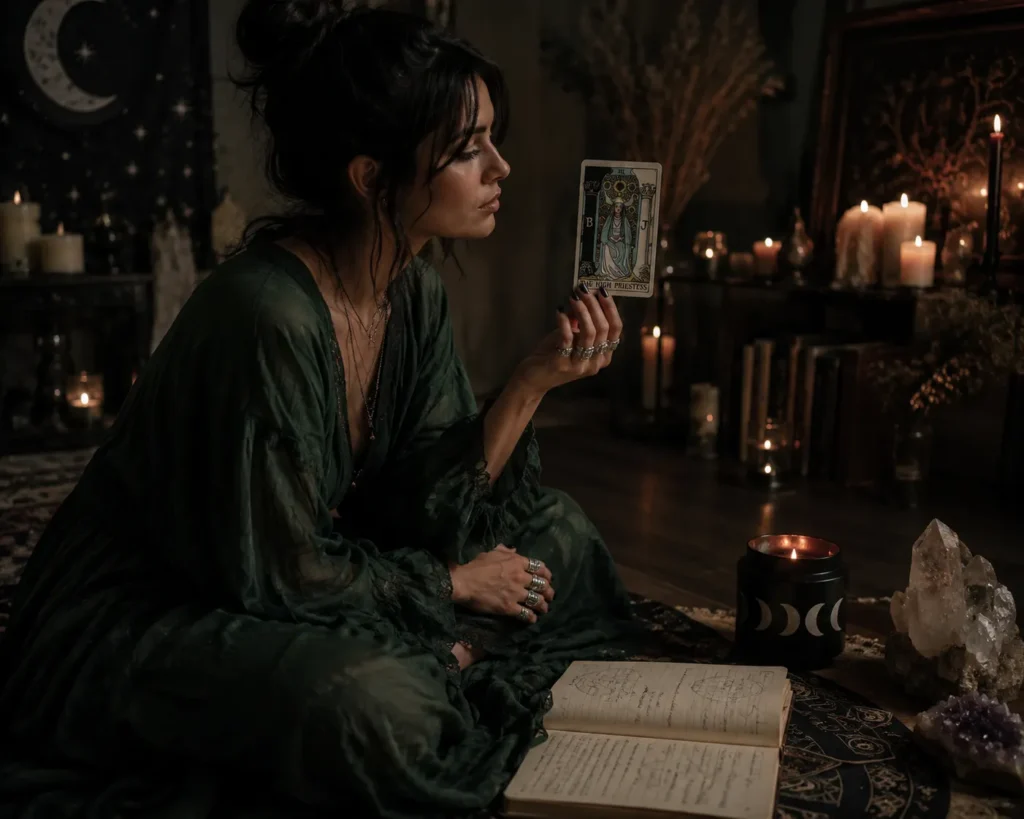
You can use this method with any card or spread. You do not need to memorize all 78 cards before beginning, but learning their traditional structure over time will give your intuitive observations more context.
A Sample Intuitive Reading: The High Priestess
Imagine that you ask, “What do I need to understand before making this decision?” and draw The High Priestess.
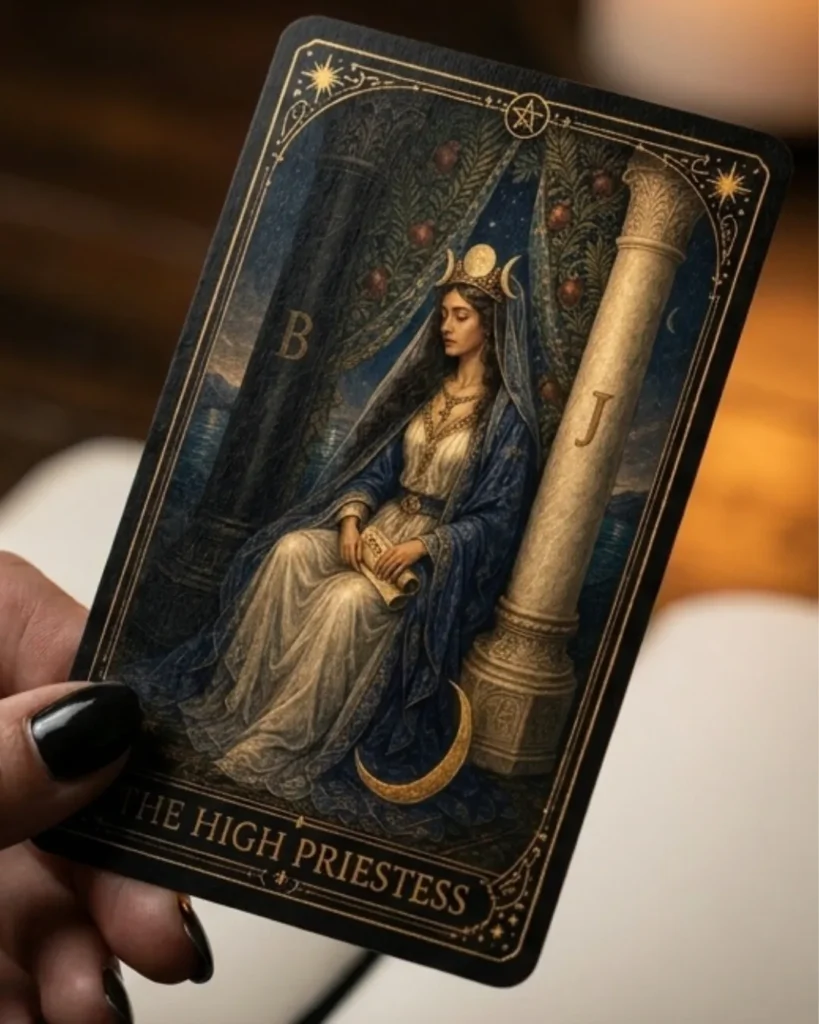
First, describe what you see without interpreting it: a seated figure between two pillars, a scroll in her hands, and a crescent moon near her feet. The scene feels still, guarded, and private.
Next, connect the image to the question. The closed posture and partially concealed scroll might suggest that not all the necessary information is available yet. The stillness may point toward waiting instead of forcing an immediate decision.
A traditional interpretation of The High Priestess includes intuition, hidden knowledge, patience, and inner awareness. That meaning supports the initial observation.
A grounded reading might be: “Pause before deciding. Pay attention to what remains unclear, gather the missing information, and notice any concern you have been trying to dismiss.”
This interpretation does not predict what will happen. It uses the card’s imagery and traditional symbolism to help examine the decision more carefully.
How to Read Reversed Tarot Cards
Reversed cards, which appear upside down, can make a beginner reading feel more complicated than it needs to be. Different readers handle reversals in different ways. Some interpret them as blocked energy, some look for a card’s more difficult expression, and others read the energy as internal rather than outwardly expressed.
You do not have to use reversed cards when you are first learning. If you choose to include them, select one framework and use it consistently while you become familiar with it. After several readings, you can decide whether that approach adds useful detail or creates unnecessary confusion.
There is no requirement to treat a reversed card as negative. Its meaning still depends on the question, its position, the surrounding cards, and the interpretation system you have chosen.
A reversed card can be an invitation to examine the card’s energy more carefully. Ask whether it feels delayed, restricted, internalized, or expressed in an unhealthy way. Use the interpretation that best fits the wider reading rather than assuming the card is predicting a negative event.
Blocked or delayed energy
The upright meaning of the card is present but not yet flowing freely — something is obstructing it. A reversed Nine of Cups (the wish card) might mean: the happiness is available, but something is blocking your access to it. This framework is practical and forward-looking — it invites the question “what is creating the block?”
Shadow expression
The difficult or unconscious side of the card’s energy is active. A reversed Emperor might represent tyranny, rigidity, or the abuse of authority rather than healthy structure and leadership. This framework deepens readings significantly and is particularly valuable when exploring shadow work or interpersonal dynamics.
Internalized energy
The card’s energy is active, but inwardly rather than outwardly — it is something you are processing privately rather than expressing or experiencing in the external world. This framework is especially useful in self-inquiry readings and works beautifully alongside the intuitive reading method above.
A reversed card is not a warning. It is an invitation to look more carefully at where the energy wants to go — and what is keeping it from moving.
Three Tarot Spreads for Beginners
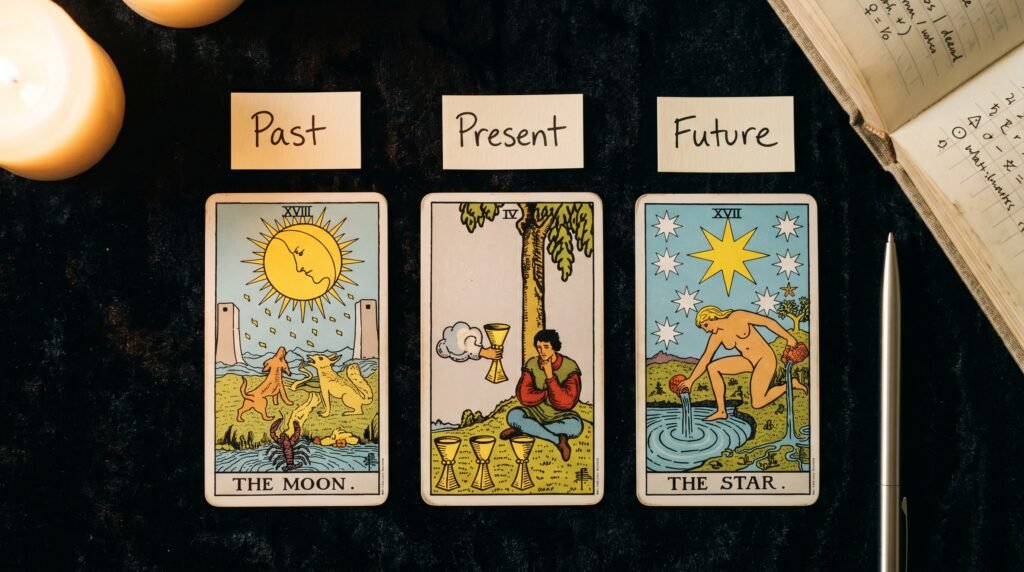
A spread is simply a framework for arranging multiple cards, with each position in the layout holding a designated meaning. Spreads give a reading structure — they prevent the paralysis of staring at three unrelated cards and trying to synthesize them without context. Begin with these three, in order of complexity.
One-Card Pull
Three-Card Spread
Five-Card Cross
How to Choose Your First Tarot Deck
When choosing your first tarot deck, start with imagery that holds your attention and feels readable to you. A deck may be popular, traditional, or beautifully packaged and still feel difficult to interpret once it is in your hands.
The Rider-Waite-Smith system is a practical starting point for many beginners because every card contains an illustrated scene and a large number of learning resources are based on its symbolism. It is not the only suitable choice, however. A botanical, celestial, dark-academia, or modern deck can also work well if the scenes are clear enough for you to observe and interpret.
Before purchasing, look through as many card images as possible. Pay particular attention to the Minor Arcana, since some decks illustrate those cards with full scenes while others use simpler arrangements of suit symbols. Choose the deck you are most likely to study, handle, and use consistently.
What to Avoid When Choosing Your First Deck
✦ Decks with abstract or non-representational Minor Arcana — these are beautiful but genuinely harder for beginners learning intuitive reading
✦ Novelty or themed decks (movie tie-ins, pop culture riffs) that prioritize aesthetics over symbolic depth — they are fun additions to a collection but weak starting points for a real practice
✦ Buying a deck before you have seen the actual card images in full — always look at a complete image gallery before purchasing; a beautiful box art does not guarantee imagery that will speak to you
Building a Consistent Tarot Practice
The deck is the center, but the practice is the whole. The most consistent readers — the ones who return to the cards month after month, year after year — are the ones who have built a small, beautiful ritual around their reading. A dedicated cloth to lay the cards on. A candle lit before the first shuffle. A journal reserved only for tarot reflections. A crystal that sits on top of the deck between uses. None of these are strictly necessary. All of them are invitations — small acts that mark the transition from ordinary time to the particular quality of attention that reading requires.
Start with One Card Tonight
The single greatest obstacle between you and a meaningful tarot practice is not the 78 cards. It is the belief that you must understand all 78 before you are permitted to begin. That belief is wrong, and it has kept more would-be readers from the practice than any other force.
Pull one card tonight. Sit with it. Describe what you see. Notice how it makes you feel. Ask where in your life that image lives right now. Write two sentences. That is a tarot reading. You just did it. Everything in this guide — the Major Arcana, the suits, the spreads, the reversal frameworks — is simply context that enriches and deepens a practice you are capable of beginning with exactly what you already have.
Tarot has changed considerably since the earliest known decks appeared in fifteenth-century Europe. What began as a card game later became a system used for divination, storytelling, reflection, and personal practice. Your relationship with it does not have to look exactly like anyone else’s.
The cards do not require expertise before you begin. They ask only that you look carefully, remain curious, and stay honest about what the images bring to mind.
The tarot does not require your expertise. It requires only your honesty — and that you already have, even if you have not yet learned to trust it.