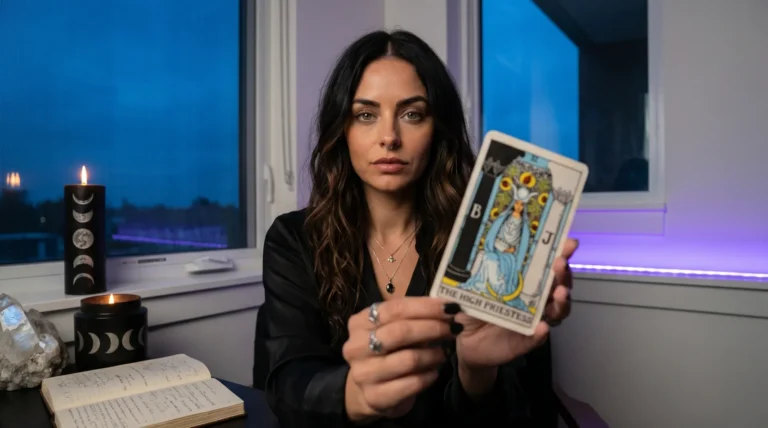

The History of Witchcraft and Superstitions: From Village Healers to Modern Ritual
Quick answer: The history of witchcraft begins with everyday folk knowledge: herbal healing, midwifery, protective charms, and seasonal ritual practiced by village healers across the ancient and medieval world. Between roughly 1450 and 1750, changing religious ideas turned that knowledge into a crime, and European courts executed tens of thousands of people, most of them women. Many superstitions we still repeat today, from black cats to spilled salt, grew up alongside that history.
The word “witch” carries centuries of baggage. For some people it still conjures a pointed hat and a bubbling pot. For others it means a healer, a rebel, or simply someone who pays attention to the moon. The real story sits somewhere more interesting than either image.
This guide walks through the history of witchcraft: where it came from, how a society’s fear transformed healers into suspects, why so many superstitions survive, and how the practice was reclaimed in the modern era. Understanding the history is part of practicing with intention now.
Key Takeaways
- Early “witchcraft” was mostly practical: herbal remedies, birth support, protection charms, and ritual timing tied to nature’s cycles.
- The European witch trials peaked between about 1560 and 1630. Most historians estimate 40,000 to 60,000 executions, and roughly three-quarters of the accused were women.
- Common superstitions, including knocking on wood and fearing broken mirrors, come from older beliefs about spirits, luck, and protection.
- Modern witchcraft is a 20th-century revival that blends older folk practice with new ideas, and today it is more open and accessible than ever.
A Timeline of Witchcraft History at a Glance
| Era | What was happening | How “witchcraft” was seen |
|---|---|---|
| Prehistory | Ritual specialists, healing plants, seasonal ceremony | Part of community life, not yet a category |
| Ancient world (c. 3000 BCE to 400 CE) | Egyptian heka, Mesopotamian incantations, Greek and Roman magic | Useful magic accepted; harmful magic punished |
| Early Middle Ages | Folk healing blends with Christian prayer | Often dismissed by the Church as illusion |
| 1400s | New theories link magic to the devil | Recast as heresy and conspiracy |
| c. 1450 to 1750 | The European witch trials; Salem in 1692 | A capital crime in much of Europe and its colonies |
| 1700s | Enlightenment skepticism, stricter evidence rules | Prosecutions fade; laws shift to punishing fraud |
| 1950s onward | Wicca and the modern Pagan revival | Reclaimed as a spiritual path and identity |
| Today | Online communities, moon apps, eclectic practice | A lifestyle, a spirituality, and an aesthetic |
Where Witchcraft Began: Healers, Herbs, and Early Ritual
Long before anyone was called a witch, people tried to understand illness, weather, birth, and death through ritual. The practices that later got labeled “witchcraft” grew out of those very human needs.
Early ritual specialists
Many early societies had people who acted as go-betweens with the unseen world: healers, seers, and keepers of plant knowledge. Archaeologists debate how to interpret prehistoric evidence, but Paleolithic cave art in France includes figures that appear part human and part animal, often read as ritual performers. What is clear is that knowledge of healing plants, birth support, and seasonal ceremony was passed down orally for generations, frequently through women.
Magic in the ancient world
Ancient civilizations built magic into daily life and, at the same time, wrote rules about it.
- Egypt treated heka (magic) as a divine force. Priests used spells, amulets, and ritual texts, including the funerary spells now known as the Book of the Dead.
- Mesopotamia left detailed incantation texts for protection, healing, and undoing curses.
- Greece used several words for magic workers, including pharmakeia (herb and drug craft), goeteia (folk sorcery), and mageia (a term borrowed from Persian priests, the magi).
- Rome accepted protective and healing magic but punished harm. The Twelve Tables, Rome’s early law code, banned charming away a neighbor’s crops.
That split between helpful magic and harmful magic runs through the entire history that follows.
Cunning folk and village wise women
As Christianity spread through Europe, older practices did not vanish. They blended. Village healers, often called cunning folk or wise women, mixed herbal remedies with prayers, saints’ names, and holy water. They set bones, helped with childbirth, found lost objects, and made protective charms. For most people, they were the only health care available.
Where Do Superstitions Come From?
Superstitions are small rituals for managing uncertainty. When people could not explain a sudden illness or a failed harvest, they created rules to tip luck in their favor. Many of those rules traveled along trade routes, blended across cultures, and picked up new meanings along the way.
Here are the origin stories most often told for some familiar superstitions. Folklore rarely has one clean source, so treat these as the most common explanations rather than settled fact.
| Superstition | Commonly cited origin | How the meaning shifted |
|---|---|---|
| Black cats are bad luck | Medieval and early modern Europe linked cats to witches and familiars | Still considered lucky in parts of Britain and Japan |
| Spilled salt is unlucky | Salt was valuable and used to preserve food | Tossing a pinch over the left shoulder became the “fix” |
| Breaking a mirror brings seven years of bad luck | Old beliefs that reflections hold part of the soul; the Roman idea of life renewing in seven-year cycles | Mirrors were also expensive, which raised the stakes |
| Knocking on wood | Folk beliefs about protective spirits in trees; Christian links to the wooden cross | Now a reflex to avoid “jinxing” good news |
| Friday the 13th | Separate old unease about Fridays and the number 13 (13 at the Last Supper) | The combined fear became popular mostly in the 20th century |
| The evil eye | Ancient Mediterranean and Middle Eastern belief in harm from an envious gaze | Blue eye amulets remain popular protective jewelry |
| Horseshoe over a door | Iron was believed to repel spirits and fairies | Now mostly a symbol of good luck |
The pattern holds even now. People still build small rituals around technology, sports, and exams. The need to feel some control over luck has not changed.
How Healers Became “Witches”: The Medieval Shift
For much of the early Middle Ages, church authorities treated magic as a delusion more than a real threat. A widely copied church text from around 906 CE, known as the Canon Episcopi, described women’s claims of flying at night as dreams planted by the devil, not actual events.
That view changed in the 1400s. Theologians began to argue that witches were real, that they made pacts with the devil, and that they met in secret gatherings to harm Christian communities. Folk practices that had been tolerated for centuries now looked like evidence of a conspiracy.
In 1486, the German clergyman Heinrich Kramer published the Malleus Maleficarum (“Hammer of Witches”), a handbook for identifying and prosecuting witches. It was never officially endorsed by the Church, and some clergy criticized it, but the printing press helped it spread widely. It became one of the most notorious books in European history, in large part because of how it framed women as especially vulnerable to the devil.
The Witch Trials: 1450 to 1750
The witch trials are the darkest chapter in the history of witchcraft, and they were not a single event. They came in waves, peaking in different places at different times, with the most intense period between about 1560 and 1630. The heaviest persecution happened in the Holy Roman Empire, especially in what is now Germany, along with parts of France, Switzerland, and Scotland.
Most historians estimate that 40,000 to 60,000 people were executed, and many more were accused, imprisoned, or tortured. Accusations usually started close to home: a sick cow, a dead child, a quarrel between neighbors. In an era of plague, war, crop failure, and religious conflict after the Reformation, people looked for someone to blame.
Torture was common in many regions, and forced confessions often named other “witches,” which fed chain reactions of new accusations.
The Salem witch trials
The best-known trials in American history took place in Salem, Massachusetts, in 1692 and 1693. After several girls began having fits, they accused local women of bewitching them. The first three accused were Tituba, an enslaved woman in the minister’s household, Sarah Good, a poor woman, and Sarah Osborne, an elderly woman who rarely attended church.
More than 200 people were eventually accused. Nineteen were hanged, and one man, Giles Corey, was pressed to death with heavy stones for refusing to enter a plea. Several others died in jail. The court accepted “spectral evidence,” testimony that a person’s spirit had appeared in a dream or vision, which made a defense nearly impossible. As doubts grew and accusations reached prominent families, Governor William Phips shut down the special court in the fall of 1692.
Why the trials ended
By the late 1600s, many judges and scholars had grown skeptical. Courts began to demand stronger evidence, and confessions extracted by torture lost credibility. Enlightenment thinking, better medicine, and changing religious attitudes all played a role.
In Britain, the Witchcraft Act of 1735 replaced older laws. Instead of punishing witchcraft as a real power, it punished pretending to have magical abilities. On the European mainland, Anna Göldi, executed in Switzerland in 1782, is often described as the last person legally executed for witchcraft in Europe. Swiss authorities formally exonerated her in 2008.
Why Were Most Accused Witches Women?
Roughly three-quarters of those accused in early modern Europe were women, though the share varied by region, and in a few places men made up the majority. Common targets included older women, widows, women living alone, and women who worked as healers or midwives.
The reasons overlapped:
- Religious ideas: Influential texts described women as spiritually weaker and more open to temptation.
- Healing and birth work: Midwives and herbalists were present at moments of illness and death, which made them easy to blame when something went wrong.
- Economic independence: Widows with property or women who supported themselves sat outside the expected family structure.
- Social friction: Many accusations began with a neighbor dispute, a refused favor, or a reputation built over years.
Seen this way, the trials were less about magic than about control: who held knowledge, who held property, and who was allowed to stand apart.
Witch Marks, Charms, and Everyday Protection
Ordinary people in the 1500s through 1700s were often more worried about being harmed by witchcraft than about practicing it. They protected their homes with symbols and objects, many of which still survive.
- Daisy wheels (hexfoils): Six-petaled flower patterns drawn with a compass and carved near doorways, windows, and fireplaces. They are among the most common protective marks found in old buildings.
- Marian marks: Overlapping V shapes (VV, for Virgo Virginum, “Virgin of Virgins”) or an M, invoking the Virgin Mary’s protection.
- Taper burns: Deliberate scorch marks left by candle flames on beams and door frames, possibly meant to protect against fire itself.
- Iron: Horseshoes and nails placed over doors or thresholds to keep spirits out.
- Witch bottles: Sealed containers of pins, nails, and other items buried near hearths or thresholds to turn away harmful magic.
- Plants and thread: Rowan branches and red thread were traditional protective charms in Britain and northern Europe.
Historians call these apotropaic marks, from the Greek word for “turning away.” Historic England has documented thousands of them in churches, houses, and barns. Notice the common thread: thresholds, windows, and chimneys, the openings through which people believed harm could enter.
“Witchcraft” Around the World: A Word on Labels
Nearly every culture has traditions of healing, divination, protection, and spirit work. But “witchcraft” is a European word, and it has often been applied to other cultures as an insult.
During colonization and the transatlantic slave trade, European authorities frequently labeled African, Caribbean, and Indigenous American religious practices as witchcraft in order to suppress them. Traditions such as Haitian Vodou, Cuban Santería (Lucumí), and Indigenous medicine practices are living religions with their own histories, lineages, and rules. Many are closed, which means they are learned through initiation or community membership, not from a blog or a video.
Respecting those boundaries is part of practicing well. We cover how to tell open and closed practices apart in our guide to modern witchcraft in the digital age.
The Modern Revival: From Gardner to the Moon-Led Life
Modern witchcraft is a 20th-century revival, not an unbroken ancient line. In 1951, Britain repealed the Witchcraft Act and replaced it with the Fraudulent Mediums Act. Three years later, Gerald Gardner published Witchcraft Today, which introduced the religion that became Wicca.
Gardner claimed he had joined a surviving witch coven, but most historians now see Wicca as a new religion that drew on folklore, ceremonial magic, and older Pagan imagery. That does not make it less meaningful. It makes it honest about being modern.
From there, the practice branched out into Wicca, Druidry, Heathenry, and eclectic witchcraft, a personal practice that borrows from many sources. Today, the craft is more visible than ever. A 2025 Pew Research Center survey found that about 3 in 10 U.S. adults consult astrology, tarot cards, or fortune tellers at least once a year.
Pop culture shifted too. The witch moved from villain to heroine, from outsider to icon. Many modern practitioners focus less on supernatural power and more on reflection, ritual, and self-trust.
What the History of Witchcraft Means for Your Practice Today
Knowing the history of witchcraft changes how you practice it. A few ideas to carry with you:
- Honor the healers. Much of what we call witchcraft began as care work. Practicing with kindness keeps that lineage alive.
- Keep the old rhythms. Moon phases and seasonal turning points guided ritual for thousands of years. Our beginner’s guide to moon phase magic is a simple place to start.
- Question the stereotype. The hat, the pot, and the hag came largely from trial records and propaganda. You get to define what a modern witch looks like.
- Practice with respect. Learn the origins of what you use, and leave closed traditions to the communities they belong to.
- Stay curious. Tools like tarot and astrology have long histories of their own worth exploring.
Frequently Asked Questions
When did witchcraft start?
There is no single starting point. Practices later called witchcraft, such as herbal healing, protective charms, and divination, appear in the earliest written records of Egypt and Mesopotamia and likely go back much further. The idea of the witch as a devil-worshipping criminal is much newer and took shape in Europe in the 1400s.
How many people were killed in the witch trials?
Most historians estimate that between 40,000 and 60,000 people were executed for witchcraft in Europe and its colonies between about 1450 and 1750. Many more were accused, imprisoned, or tortured. In Salem, 19 people were hanged, one man was pressed to death, and several others died in jail.
Why were black cats associated with witches?
In medieval and early modern Europe, some people believed witches kept animal helpers called familiars or could shape-shift into cats. Black cats, already linked with night and darkness, became part of the stereotype. In other cultures, including parts of Britain and Japan, black cats are considered good luck.
What are witch marks?
Witch marks, also called apotropaic marks, are protective symbols carved or burned into buildings, mostly between the 1500s and 1700s. Common examples include daisy wheels, overlapping V shapes that invoke the Virgin Mary, and candle scorch marks. They were placed near doors, windows, and fireplaces to keep harm out.
Who wrote the Malleus Maleficarum?
The Malleus Maleficarum was written by Heinrich Kramer, a German clergyman, and first published in 1486. Jacob Sprenger is often listed as co-author, though historians debate his involvement. The Church never officially adopted it, but it became one of the most influential witch-hunting manuals in Europe.
Is modern witchcraft the same as historical witchcraft?
No. Modern witchcraft, including Wicca, is a 20th-century revival that draws on folklore, ceremonial magic, and older traditions. Most people executed in the historical trials were not practicing witchcraft as a religion at all. Many were simply unpopular, vulnerable, or unlucky.
Final Takeaway
The history of witchcraft is a story about knowledge, fear, and power. It begins with healers and herbs, turns dark in the courtrooms of early modern Europe, and ends, for now, with a revival that invites anyone to practice openly. The superstitions we still repeat are small echoes of that long story.
Ready to see how the craft looks today? Continue with Modern Witchcraft in the Digital Age, or start working with the lunar cycle through our moon phase magic guide.